The README for reelcut has been overhauled to provide a practical, walkthrough-style guide rather than a simple feature list. It now includes clear prerequisites, installation instructions, a breakdown of the rendering workflow, and concrete examples of output to help users troubleshoot common issues like missing assets. 
Completed a comprehensive update to the reference documentation for the reelcut skill, resolving seven broken links that previously made the skill unrunnable. Added critical operational details regarding script composition, data verification, and archetypal constraints to ensure consistent and high-quality outputs. This change ensures that the skill is fully functional and properly documented for end-users. 

This update introduces a more proactive asset intake system and clearer feedback when assets are missing. Instead of stalling silently, the pipeline now provides actionable resolution paths—such as capture, substitution, or reconfiguration—based on asset requirements. Matching heuristics were also refined to prevent false positives by enforcing whole-word matching and prioritizing precise metadata. 
The checkVideo script previously failed to find video files when invoked via pnpm --filter because it relied on the current working directory, which pointed to the package folder rather than the repository root. By utilizing INIT_CWD, the script now correctly resolves file paths relative to where the command was originally executed, improving developer ergonomics. 
We've implemented a new Hyperframes render route, establishing a path to eventually retire the Remotion-based rendering engine. This update includes fixes for critical bugs found during testing, specifically addressing Node.js spawn constraints with .cmd files and correcting JSON report parsing to accurately track layout samples. With 156 of 158 project files already mechanically compatible, this change sets the stage for a cleaner, more robust rendering pipeline. 
Introduced a new short-form mode optimized for 15-25s clips, ensuring structural integrity by strictly preserving the first and last beats while intelligently sampling intermediate content. Centralized critical timing constraints like 'readingFloorSeconds' and 'lineFitsDuration' into the core package to prevent logical drift across the director, planner, and authoring modules. These changes improve pacing and consistency, ensuring generated cuts remain watchable and punchy regardless of the source material length. 
We've implemented a new 'beat brief' director that shifts the creative workflow from selecting rigid templates to describing the desired outcome of a beat. By enforcing strict schemas and arithmetic reading floors, the system now provides actionable feedback when models struggle, reducing silent failures and improving output quality. This approach removes restrictive vocabulary lists, allowing for more creative and accurate visual compositions. 
We have deprecated the heavy 88k-LOC composition engine in favor of 'direct-beat', a concise set of 8KB prose instructions for managing animation composition. By focusing on explicit rules for reading speed, layout transitions, and ground-truth commitment, this change significantly improves composition quality and performance metrics while reducing maintenance surface area. 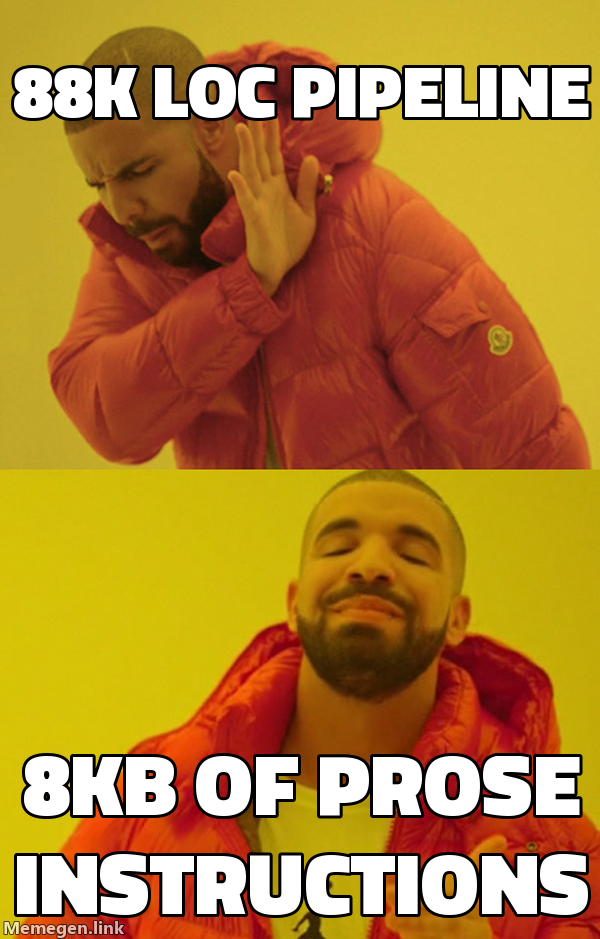
This update introduces a manually authored HTML and GSAP version of 'beat 11' to overcome limitations in the automated ScenePlan-based compilation. The manual implementation significantly improves visual timing and layout logic, resolving rendering defects where content was previously truncated or poorly spaced. This experiment confirms the value of manual control for complex scene timing, highlighting issues like overlapping text and improper logo rendering in the automated approach. 
To support free-form authoring where compile-time layout data is unavailable, validation gates have been moved from analyzing the IR to analyzing decoded video frames. This update introduces robust metrics—including luminance-based emptiness checks and boundary contrast analysis—to detect rendering issues like blank panels or clipped content. These engine-neutral checks now successfully identify visual defects without false positives across the test corpus. 
We've added three new blog posts exploring the evolving landscape of AI agents in development workflows. These articles cover the critical gaps in "vibe coding" PR reviews, adopt a blast-radius framework for agent permissions, and analyze the nuances of the Revolut phishing incident. These reads aim to help developers better navigate the security and operational challenges of integrating AI into their toolchains. 

Synchronized the enrichment metadata, including star counts and last commit timestamps, for the supported server integrations. This automated update ensures that the application displays accurate, up-to-date information about the available tools and services. 
This update introduces a major overhaul of site-wide SEO and AEO practices, including fixed canonicals, structured metadata, and proper OG/Twitter image generation for blog posts. I've added support for RSS, sitemaps, and AI-readable formats like llms-full.txt to ensure content is accessible to both traditional search engines and AI models. These changes significantly improve site discoverability and metadata accuracy across all pages. 
We've added four new SEO-focused skills to the skills-lock.json configuration: ai-seo, programmatic-seo, seo-aeo-best-practices, and seo-audit. These additions expand the available marketing capabilities, allowing for more comprehensive SEO-related tasks and optimizations.
We've overhauled the application's search engine presence by adding comprehensive SEO and AEO metadata. This includes automated OG/Twitter cards, structured JSON-LD data, a sitemap, and AI-optimized files like llms.txt and pricing.md to ensure better indexing by modern search and AI answer engines. Additionally, a new icon generation script streamlines favicon and PWA icon management across all platforms. 
Updated the hero mockup image on the landing page to better showcase the platform. The browser mockup component now displays a refreshed dashboard screenshot.
This update focuses on performance by removing heavy client-side features like the adaptive pointer and refactoring expensive animation loops to be more efficient. Key changes include switching to lerp-based scrolling, reducing PRISM render resolution for high-DPI displays, and optimizing how scroll events trigger updates to ensure the landing page remains responsive. 
We've significantly upgraded the landing page experience by introducing advanced motion effects and pointer interactions. Key changes include switching to 'Reveal' animations, implementing liquid-glass styling, and integrating the 'ogl' library for enhanced graphics capabilities. These refinements across nearly all landing components ensure a more dynamic, responsive, and engaging user interface. 
We updated the AiScene composition to utilize the same phase-based model as our static blueprints, introducing ESTABLISH, ACTION, DEVELOPMENT, and PAYOFF stages. This move replaces the previous repetitive, timer-based animation loop with semantic, multi-moment developments that vary across different actors in the composition. Scenes now feel much more deliberate and less like repetitive vibrations, with duration-aware scheduling to ensure short beats aren't over-animated. 
This update refines the visual presentation and timing for card layouts and title reveals. I updated grid_card_assemble to correctly fill the designated stage area rather than floating thin content, ensuring better proportional scaling. I also extended the motion sequences in titlecard_reveal to remove dead air during longer beats, resulting in more consistent and intentional visual pacing.